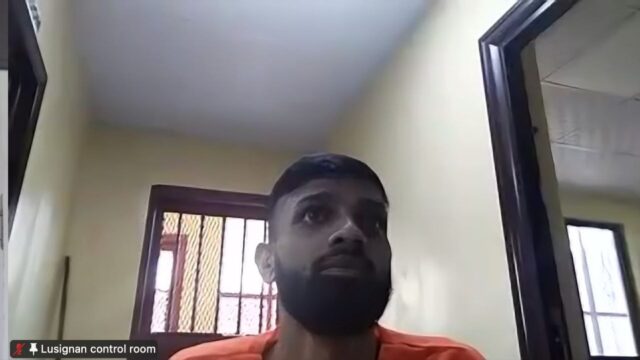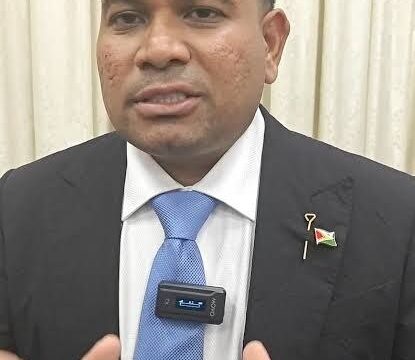
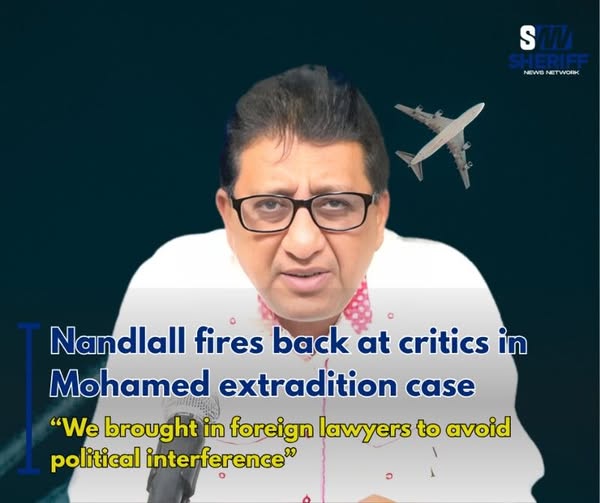

Attorney General and Minister of Legal Affairs, Anil Nandlall, SC, is continuing to clarify key aspects of the ongoing extradition proceedings involving Nazar and Azruddin Mohamed, as public claims continue to circulate regarding the role and payment of lawyers involved in the matter. Speaking during a recent interview, Nandlall addressed suggestions that the Government of Guyana had unusually hired and is funding a team of internationally recognised attorneys to prosecute the case.
He explained that the legal representation was not selected arbitrarily, nor is the arrangement outside of established extradition practice.
“As I’ve explained before, in extradition proceedings, the request comes from a foreign state. In this case, it is the U.S. government. The lawyers who are prosecuting this request are representing the interest of the United States government. The requesting state is whose interest is being prosecuted. So most naturally, they have a say in who will represent their interest,” the Attorney General stated.
He noted that international extradition processes are governed by long-standing principles of reciprocity, where one state provides certain responsibilities when handling requests on behalf of another.
“Under international extradition law and practice, under committee and reciprocity which govern extradition processes across the globe, the country to whom the request is made discharges the obligation of providing that legal counsel, that legal representation, obviously with the approval of the U.S. authority,” he said.
According to Nandlall, Guyana opted for lawyers from outside the country in order to ensure that there would be no claims of political involvement.
“In this case, because we wanted to avoid and insulate the process from the allegation of political interference, lawyers from outside of Guyana were brought in with the approval of the U.S. government. And yes, the government of Guyana has to pay for that.”
He pointed out that this approach is standard across the region and internationally.
“Anybody can challenge me and call around the Caribbean or anywhere else and find out if that is not the usual practice. Go right to Trinidad and Tobago and you will see British Queen’s Council are brought from England to represent the prosecution in Trinidad and the Trinidad government pays for that on a regular basis. And that happens across the globe.”
To demonstrate the principle of reciprocity, Nandlall highlighted the extradition of Marcus Bisram from the United States to face a murder charge in Guyana.
“Guyana requested Bisram in Guyana from the United States to stand trial for murder in Guyana. The U.S. government provided legal services and paid for those services and then sent Bisram back here. That is the reciprocal responsibility and arrangement. That’s what reciprocity means. You do for me and I do for you,” he explained.
Turning to criticism raised specifically against one of the attorneys involved, the Attorney General responded to concerns regarding attorney-at-law Glenn Hanoman’s role in the matter. He stressed that Hanoman does not live in Guyana and has extensive experience in extradition law.
“First of all, Glenn Hanuman lives in Portugal. He doesn’t live in Guyana. So that satisfies the very requirement. None of the lawyers are ordinarily resident in Guyana, including Glenn Hanuman. Glenn Hanuman migrated from this country several years ago and lives in Portugal. And the US government also requested Glenn Hanuman to represent their interests. What do you want Guyana to do? Reject them?”
He further noted that Hanoman is a senior defence attorney with years of criminal practice and prior involvement in extradition proceedings.
“Plus, Glenn Hanuman is very experienced in extradition matters. And I don’t know if Glenn Hanuman is a PPP lawyer. I can’t remember any political case in which Glenn Hanuman appeared with me for the PPP.”
Nandlall also questioned the logic behind demands that the Mohameds should influence who prosecutes the case.
“You can’t tell the American government who you want to prosecute you. At what level does that make sense? You’re choosing your own prosecutor. Would he like for the Americans to determine who will defend him? If that’s the position, then, you know, it’s fair play. Let the Americans determine who will defend him if he wants to dictate who will defend the US interests.”
The extradition matter is ongoing.