
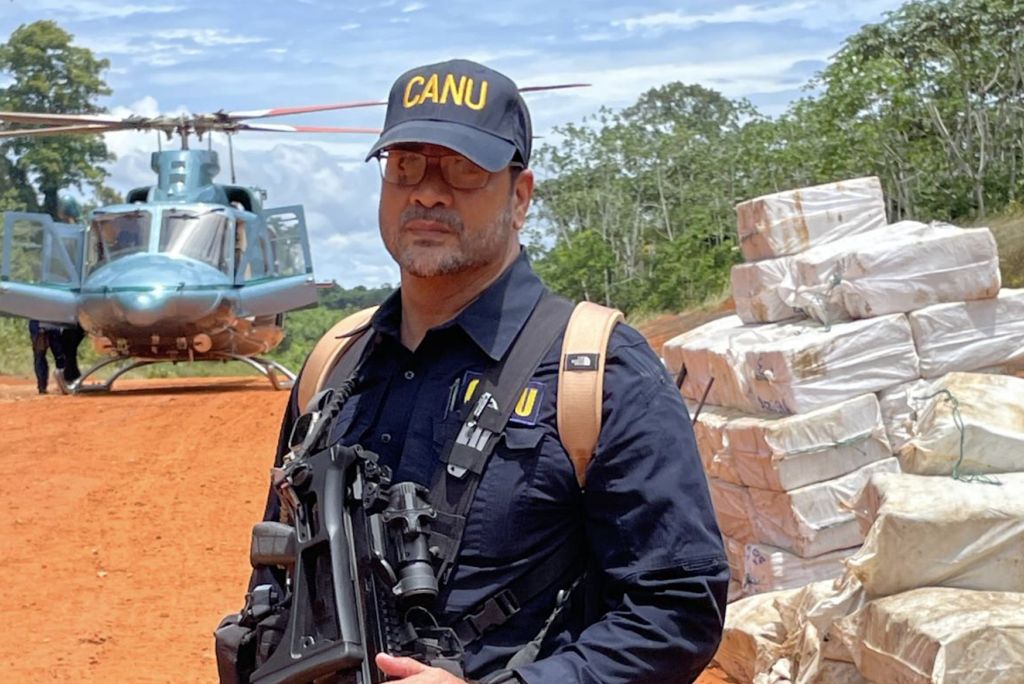
Guyana is facing new and dangerous challenges in the fight against narcotics, with synthetic drugs like ecstasy now entering the country, according to James Singh, Director of the Customs Anti-Narcotic Unit (CANU).
Speaking on the programme Safeguarding Our Nation, Singh described the emergence of synthetic drugs as “the most challenging” development in recent years.
“We’re seeing new drugs such as MDMA [Methylenedioxymethamphetamine], or ecstasy, synthetic drugs coming from Europe into Guyana and then to other parts of South America,” he said.
In addition to synthetic substances, Singh pointed to an influx of high-potency marijuana that poses its own risks.
“We’re also seeing the presence of foreign marijuana—this is marijuana with a higher tetrahydrocannabinol (THC) content coming from North America, Colombia, Venezuela, as well as far as Thailand—coming into Guyana and then going to other parts of South America,” he explained.
These trends, Singh warned, illustrate how traffickers are diversifying their activities. According to him, they are no longer only moving cocaine through Guyana but also exploiting the country as a route for new narcotics with potentially severe impacts on public health.
The CANU Director further highlighted the troubling presence of foreign operatives seeking to establish themselves in Guyana.
“Also, the presence of foreign members of drug trafficking organisations trying to embed themselves here in Guyana,” Singh noted.
“Recently we’ve seen numerous foreign members held alongside Guyanese outside of Guyana with large amounts of cocaine. Again, this is an indication that they’re trying to establish somewhat of a presence here.”
As narcotics flow into and through Guyana, traffickers are also turning to new methods of hiding their cargo. “There are new methods of concealment. No longer are persons trying to hide cocaine in wood or in fish,” Singh said.
“What they’re doing now is contaminating commercial shipments after they would have been scanned, after they’d have been checked by law enforcement, and contaminating them at transshipment points.”
He added that traffickers are also exploiting Guyana’s maritime space: “We’re also seeing them load vessels off the coast. A vessel comes in, it has legitimate cargo, but then it travels outside of Guyana in our territorial waters, and they load narcotics onboard.”
To counter these evolving threats, Singh explained that CANU is turning to technology and strengthening alliances at home and abroad. “What we’re doing also is working with our international partners. We are calling for more presence of foreign liaison officers to work alongside us in the fight against drugs,” he said.
Locally, CANU is using advanced detection tools. “We’re also using technology. CANU has acquired scanners and other bits of technical equipment to help us identify some of these concealment methods,” Singh noted.
The agency is also working with partners such as the Maritime Administration Department (MARAD) and the Guyana Defence Force Air Corps to detect suspicious maritime and aerial activities.
Singh underscored that these efforts are not just about intercepting shipments but about protecting Guyana’s reputation and security. “We’re trying to ensure that Guyana does not become a haven, does not become a narco-state, that drug trafficking organisations see here as a bad place to do business,” he declared.
The determination, he said, is rooted in both institutional commitment and national will. Success depends on “two reasons: CANU’s zeal to fight drugs, and the government’s commitment in ensuring that Guyana does not become a narco-state or its citizens feel threatened by the narcotics trade.”
According to him, as Guyana contends with new waves of synthetic drugs, high-THC marijuana, and increasingly sophisticated trafficking networks, CANU’s role remains central.
The agency, Singh insisted, is adapting to meet the challenge head-on with technology, intelligence sharing, and international cooperation.