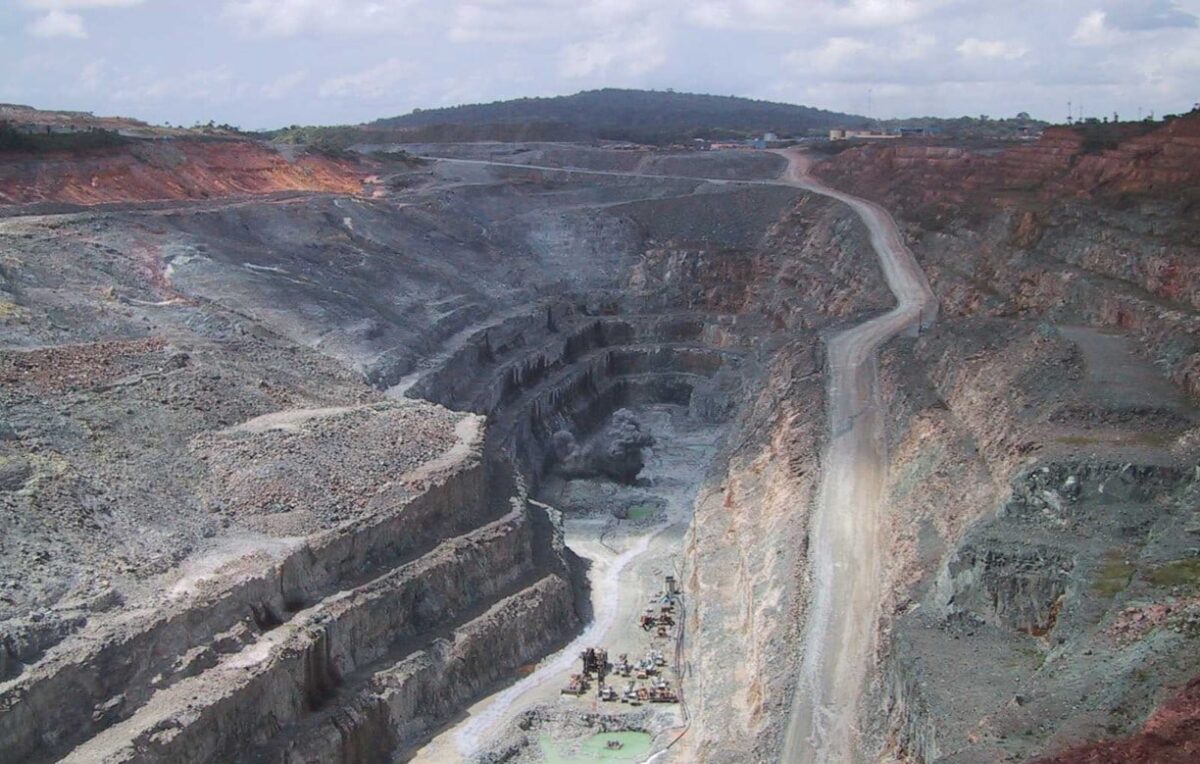
Omai Gold Mines says its updated mineral resource estimate has pushed the Omai Gold Project further into large-scale territory, with the company now reporting 2.495 million ounces of gold in the Indicated category and 5.465 million ounces in the Inferred category across the Wenot and Gilt deposits. The company is also positioning the project as a major long-term redevelopment candidate, with a Preliminary Economic Assessment now expected within two to three months. In a release dated April 14, Omai said the updated estimate for its 100%-owned Omai Gold Property reflects expansions at both the Wenot and Gilt deposits. Overall, the combined Indicated resource rose by 17.6% to 2.495 million ounces at an average grade of 2.04 grams per tonne, while the combined Inferred resource increased by 24.7% to 5.465 million ounces at 1.59 grams per tonne. Company President and CEO Elaine Ellingham said the update “reinforces Omai’s position as the largest gold project in Guyana,” while arguing that the property’s location and existing infrastructure continue to strengthen its development case. She said Omai has road access, an on-site airstrip, a cleared site, known metallurgical recoveries and established tailings sites, while also describing Guyana as “a favourable jurisdiction for permitting with Government and communities’ support for large-scale mine development.” Ellingham further said the latest estimate is the company’s fifth for the project and “again reinforces the potential for large-scale mine re-development at Omai.” According to her, “with each successive milestone it becomes even clearer that Omai has the potential to be a multi-decade large-scale gold mining operation.” The biggest movement came from the Wenot deposit, where the Indicated resource climbed 49.8% to 1.453 million ounces of gold in 28.4 million tonnes, grading 1.59 grams per tonne. The Wenot Inferred resource also rose by 7.6% to 3.999 million ounces in 92.4 million tonnes at 1.35 grams per tonne. Omai said recent drilling and refined geological modelling supported that expansion, while also helping convert a significant portion of previously inferred material into the higher-confidence Indicated category. The company said 31 diamond drill holes totalling 15,004 metres since the August 2025 estimate helped refine the Wenot model. It said the additional work supported an important step toward the upcoming PEA, since the revised geological model and mineralized zones now form the basis for an optimized mine plan. Omai said one of the objectives of drilling over 2024 and 2025 was to begin converting the large Inferred resource at Wenot into Indicated ounces, and it reported that recent drilling added 483,000 ounces to the Indicated category. Even with that conversion, Omai said Wenot still remains open for more expansion. Ellingham said both Wenot and Gilt are open at depth, adding that a deep hole drilled below Wenot in 2025 established the presence of the Wenot shear, which hosts seven gold zones, some 700 metres below the known deposit. At Gilt, the updated estimate showed a mixed but still materially larger overall resource. The Indicated resource declined by 9.5% to 1.042 million ounces at 3.33 grams per tonne in 9.7 million tonnes, while the Inferred resource jumped 120.3% to 1.465 million ounces at 3.22 grams per tonne in 14.2 million tonnes. Omai said the increase in inferred ounces came mainly from re-examining data from the upper part of the deposit and from deeper drilling, which showed mineralized zones extending into surrounding volcanic rocks. The company said two additional deep holes drilled across Gilt in 2024 and 2025 were included in the updated estimate. It also said a revised resource model identified 26 separate gold mineralized zones at Gilt, up from 11 in the previous model, allowing tighter definition of mineralization and less waste within the zones for future mine planning. As for the reduction in Gilt’s Indicated ounces, Omai said that came as the estimate applied a slightly higher cut-off grade of 1.7 grams per tonne instead of 1.5 grams per tonne, along with greater selectivity in defining mineralization domains and more restrictive criteria for classifying Indicated blocks. Even so, the grade of the Indicated resource increased from 3.22 to 3.33 grams per tonne. The release said the mineral resource estimate uses a gold price assumption of US$3,000 per ounce. For Wenot, the open pit cut-off grades remain at 0.20 grams per tonne for soft rock and 0.30 grams per tonne for hard rock, while the underground cut-off grade is 1.70 grams per tonne. Omai also said process recoveries were assumed at 90% for Wenot alluvium and saprolite, 92% for Wenot transition and fresh rock, and 92% for Gilt. Looking ahead, Omai said a 50,000-metre drill programme is already underway with five drills turning. Ellingham said the company is continuing to drill aggressively “to increase the Mineral Resources and to upgrade the Inferred Resources, as we set our sights on a future Prefeasibility or Feasibility Study.” She added that drilling is now focused on Wenot and certain nearby targets. The company said the effective date of the updated mineral resource estimate is April 7, 2026. It added that the estimate was prepared in accordance with Canadian Institute of Mining standards and National Instrument 43-101 disclosure rules, with Alan J. San Martin of SLR Consulting identified as the qualified person for the mineral resource estimate. Omai Gold noted that the historic Omai mine produced more than 3.7 million ounces of gold between 1993 and 2005, before operations ceased when gold was below US$400 an ounce. The company said the current project benefits from that legacy infrastructure and is connected by road to Georgetown and Linden.
Omai resource jumps to nearly 8Moz, company eyes multi-decade gold operation in Guyana